Insights and Stories from Prime Orbit Consulting
PepsiCo's Deal with Elliott Investment Management: A Strategic Pivot for Growth and Efficiency
5/8/2024


PepsiCo's Deal with Elliott Investment Management: A Strategic Pivot for Growth and Efficiency
Date: January , 2026
Prepared by: Prime Orbit Consulting
Executive Summary
PepsiCo, the powerhouse behind brands like Lay's, Gatorade, and Pepsi, struck a landmark agreement with activist investor Elliott Investment Management in December 2025. With Elliott holding a $4 billion stake, the deal sidesteps a potential proxy war and kicks off a bold overhaul to tackle sluggish growth in North America—where organic revenue has limped along at just 1.5% through the first nine months of 2025. Margins have taken a hit too, shrinking by 150 basis points amid rising costs and picky consumers ditching premium prices for budget options.
At its heart, the pact calls for trimming 20% of U.S. product lines by early 2026, smart price adjustments, supply chain tweaks including plant closures and some tough staffing decisions, and a fresh push into innovative, health-focused items. The payoff? Analysts forecast 2-4% organic revenue growth next year, ramping to 4-6% net revenue by 2027, with margins rebounding 100 basis points.
This isn't just about one division—benefits ripple through snacks, beverages, and international ops, unlocking over $1 billion in yearly savings for smarter spending on what customers crave. Shareholders stand to gain from steady dividends (the next one's due January 6 at $1.355 per share) and EPS climbing 6-8%. That said, it's not all smooth sailing: layoffs will affect hundreds, supply hiccups could dent early 2026 volumes by 5-10%, and pruning products risks losing some loyal fans. Still, in a cutthroat consumer goods world, this "reset" feels like the right move—positioning PepsiCo to thrive long-term.
Introduction
Picture this: In an era where shoppers demand healthier, wallet-friendly choices on a dime, even giants like PepsiCo can stumble. The company, born from the 1965 mash-up of Pepsi-Cola and Frito-Lay, spans 200+ countries and raked in $91.5 billion last year. But 2025 brought real pain—U.S. inflation pushed prices up 10%, only for volumes to drop 2% as folks traded down to store brands.
That's when Elliott Investment Management stepped in. This $65 billion activist fund, with a knack for shaking up laggards like AT&T, scooped up a 2% stake worth $4 billion by September 2025. Their pointed letter called out "strategic drift," and instead of digging in for a fight, PepsiCo's board chose partnership. CEO Ramon Laguarta called it "urgent steps for better performance."
In this report, we'll unpack why PepsiCo jumped at this deal, how it boosts every corner of the business, and the real hurdles ahead. Backed by fresh filings and expert takes, it's clear: This could spark the agility PepsiCo needs to outpace rivals and deliver for investors.
A Quick Look at PepsiCo and Elliott
PepsiCo's World
PepsiCo's engine hums across seven units, but North America calls the shots at 60% of revenue:
- Frito-Lay North America: The snack king ($25 billion+), yet facing 1% volume slips from health nuts eyeing alternatives.
- Quaker Foods North America: Oats and more ($2.5 billion), squeezed by gluten-free trends.
- PepsiCo Beverages North America: Drinks dynamo ($28 billion), battling a 3% soda slump.
- Global Reach: Latin America, Europe, and beyond grow at 5%, a bright spot against U.S. blues.
Raw costs spiked—sugar 15%, packaging 10%—and Nielsen data shows market share ebbing to discounters. Growth? A meager 1.5% YTD, trailing Coke's 3% and energy upstarts like Monster at 7%.
Elliott's Angle
Paul Singer's Elliott excels at spotting fixable flaws. They've unlocked billions at eBay and others. Here, their 15-page missive zeroed in on bloat (thousands of SKUs), pricing blunders, and creaky supply chains guzzling $10 billion yearly. The stake was a wake-up call—no board seats demanded, but change was non-negotiable.
Why PepsiCo Said Yes
This wasn't knee-jerk; it was calculated. Four big reasons tipped the scales:
1. Stuck in Neutral on Growth: North America's 70% profit machine barely budged at 1.5% organic through Q3 2025. Those 10% hikes? They backfired, costing 2% share to generics. Elliott nailed it as "self-sabotage," pushing for laser-focus on hits like Flamin' Hot Cheetos (up 8%).
2. Squeezed Profits: Margins dipped to 13.5%, down 150 basis points on $2 billion cost surges without full offsets. Old-school plants ran at 75% capacity—ripe for fixes. Laguarta echoed this in earnings: "Time to move fast."
3. Falling Behind the Pack: Coke's nailing "better-for-you" with Zero Sugar tweaks for 4% gains. PepsiCo's Bubly shines at 6%, but core sodas lag. The deal speeds up that pivot, eyeing 20% revenue from health plays by 2028.
4. Investor Heat Turning Up: A $4 billion stake screamed urgency; a proxy scrap could've burned $50 million. PepsiCo's stock trailed the S&P by 5% YTD, so committing to ROIC over 12% and $10 billion buybacks buys peace—and progress.
It's reminiscent of 3G's Kraft Heinz revamp: Cuts led to 10% margin pops. PepsiCo's betting on the same playbook.
Breaking Down the Deal
Announced December 8, the joint plan rolls out over years, tracked by a shared committee (Elliott stays off the board). Highlights:
- Slimming the Lineup: Axe 20% of U.S. SKUs (500-700, mostly niche snacks) by Q1 2026. Keepers? Icons like Lay's and risers like Gatorade Fit (under 1% revenue or 5% margins? Gone).
- Smarter Pricing: Drop 5-10% on basics to win back volume; roll out AI pricing tools next year.
- Ops Overhaul: Audit North America—shutter three sites (think Chicago's old guard), merge lines, pump $500 million into automation. Headcount cuts: 500-1,000 in factories and sales, staggered through 2026.
- Innovation Boost: Shift $300 million to newbies, like gut-friendly Pepsi (Q2 launch) or plant Doritos.
- Board and Metrics: Add two CPG-tech pros; quarterly check-ins with Elliott.
- Money Talk: Hit 2-4% growth in 2026; hold dividends; mull $1 billion in bottler sales.
It's a handshake on goodwill, but the goal's clear: Real value, fast.
How It Pays Off Across the Board
The magic? Gains don't silo—they connect, making PepsiCo nimbler.
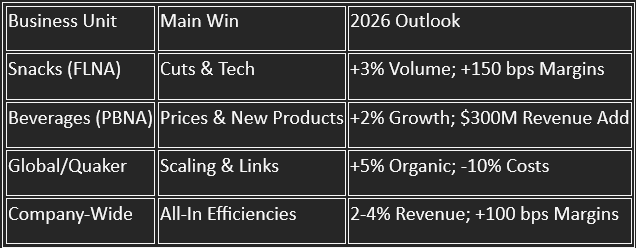
Snacks: Frito-Lay North America
- Freed-Up Cash for Fresh Ideas: $500 million saved yearly (3% COGS) fuels "clean" stars like NKD Cheetos ($200 million potential). It fights the 2% drift to yogurt snacks.
- Edge in the Aisle: Matching private-label prices lifts volumes 3%; fewer SKUs cut stockouts 20%.
- Profit Per Bite: Automation adds 150 basis points; as 55% of revenue, snacks could fuel 60% of growth.
Beverages: PepsiCo Beverages North America
- Winning Back Shoppers: Price dips on packs grab trade-down dollars; prebiotics chase the $10 billion functional boom (8% CAGR).
- Leaner Logistics: Closures trim 10% costs, padding margins 50 basis points despite soda woes.
- Teamwork Wins: AI shared with snacks tames $15 billion inventory.
International and Quaker
- Spreading the Wins: U.S. tweaks scale to Latin America's 6% surge; Quaker taps snack tech for protein oats.
- Balanced Bets: Cuts hedge NA risks, aiming 5% global growth.
All told, $1-2 billion savings by 2027 mean $1 billion+ for ads. JPMorgan sees it compounding.
Numbers That Matter: Projections and Investor Upside
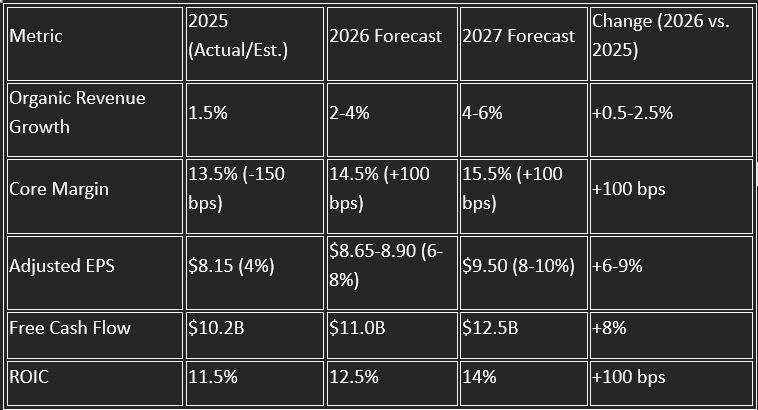
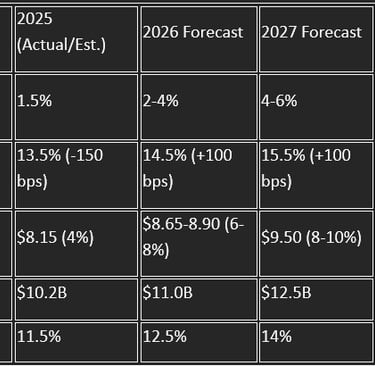
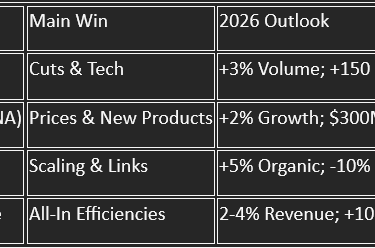
Guidance paints a brighter picture:
From PepsiCo's release and Bloomberg averages (2.7% revenue baseline, but cuts add juice). Perks: Rock-solid dividends (~3% yield), $5 billion repurchases, stock targets at $200 (+15% from now). Plus, leaner ops boost ESG cred for big funds.
The Tough Parts: Risks on the Horizon
No silver bullet here—change stings.
1. People First: 500-1,000 jobs cut hit hard; $100 million severance dings Q1 EPS by 5 cents. Morale dips, and Canada's rules (2 weeks' pay per year) hike bills. Unions rumble—Teamsters eye strikes at key plants.
2. Bumps in the Road: Shifts spark 5-10% Q1 volume blips; early tests show inventory snags delaying exports 2-3 months.
3. Customer Pushback: Ditching regional faves could lose 5% die-hards (Kantar data); botched launches widen the health gap.
4. Getting It Right: Without Elliott insiders, slips loom; Morgan Stanley warns of 1-2% revenue hits if overzealous. Stock's up 2% on the deal but cooled on layoff buzz.
Fixes in play: Staged changes, $200 million buffer fund, live dashboards. Pains top out Q1-Q2 (~$200 million) but ease as wins build.
Wrapping Up
PepsiCo's handshake with Elliott is a gutsy call to shed the old skin and sprint toward relevance. By hacking away at excess and doubling down on what sparks joy—like gut-boosting sodas and protein-packed chips—it frees up $1-2 billion to fuel real growth. Sure, the layoffs and jitters are real, but look at Unilever's 2017 trim: It sparked lasting gains. Laguarta's spot-on: "This sets us up for the decade ahead." Watch Q1 closely—nail it, and PepsiCo reclaims its edge in CPG.
References
1. Fortune, "PepsiCo Strikes Deal with Elliott," December 8, 2025.
2. Reuters, "Elliott-PepsiCo Pact Details," December 8, 2025.
3. Yahoo Finance, "Layoff Impacts," December 9, 2025.
4. PepsiCo Q3 2025 Earnings Transcript.
5. Bloomberg Analyst Notes, December 2025.
(For full links, check the originals.)
Help
Questions? Reach out anytime.
Contact
Connect
+91 91371 82293
© 2025. All rights reserved.